
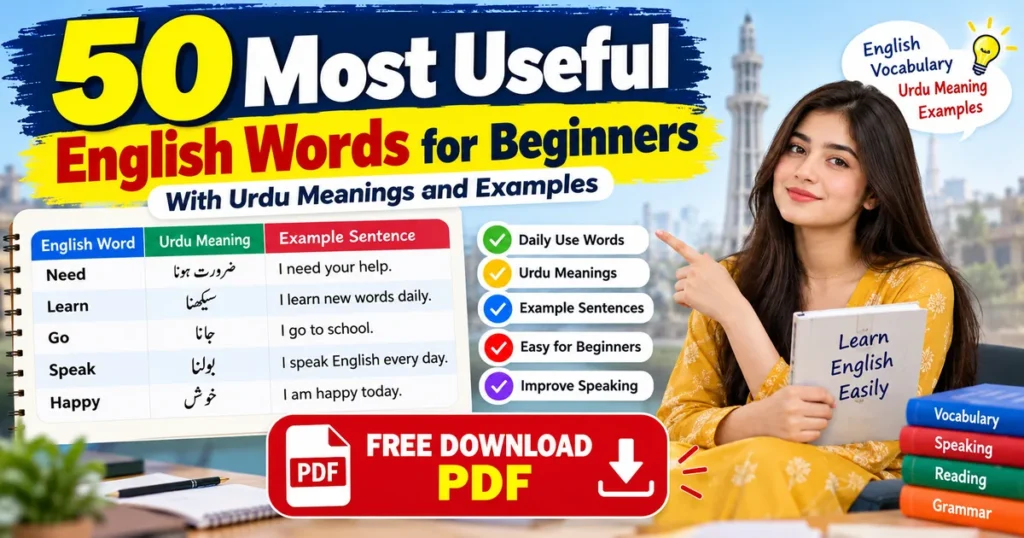
Learning English becomes easier when you start with words you can use in everyday conversations. If you are a beginner, you do not need to memorize hundreds of difficult words. Start with simple English vocabulary, understand its Urdu meanings, and practice using each word in a sentence.
This guide covers 50 useful English words for beginners with Urdu meanings and example sentences. These words help you talk about daily activities, express feelings, ask questions, and communicate at home, school, or work.
Whether you are a student, job seeker, or someone improving spoken English, this vocabulary list offers a practical starting point.
Free PDF Download
Get all 50 beginner English words with Urdu meanings and example sentences in one printable PDF. Practise offline anytime.
Download Free PDFWhat Are the Most Useful English Words for Beginners?
The most useful English words for beginners include need, want, have, make, go, come, know, think, help, and learn. These words express common actions, needs, and ideas in everyday English.
For example:
- Need (ضرورت ہونا): I need some water. — مجھے تھوڑا پانی چاہیے۔
- Want (چاہنا): I want to learn English. — میں انگریزی سیکھنا چاہتا ہوں۔
- Help (مدد کرنا): Please help me. — براہِ کرم میری مدد کریں۔
- Learn (سیکھنا): I learn new words daily. — میں روزانہ نئے الفاظ سیکھتا ہوں۔
- Know (جاننا): I know the answer. — مجھے جواب معلوم ہے۔
These words are useful because you can combine them with different subjects, objects, and expressions to create many sentences.
If you want to expand your vocabulary, explore our collection of English vocabulary with Urdu meanings.
50 Daily Use English Words With Urdu Meanings
The following vocabulary list contains 50 English words divided into five practical categories. Each word includes its Urdu meaning and a simple example sentence.
1. Common English Action Words With Urdu Meanings (1–10)
Action words, also called verbs, describe what people do. Beginners can use these verbs to discuss daily routines, personal needs, and activities.
| No. | English Word | Urdu Meaning | Example Sentence |
|---|---|---|---|
| 1 | Need | ضرورت ہونا | I need your help. |
| 2 | Want | چاہنا | I want a new book. |
| 3 | Have | پاس ہونا / رکھنا | I have a pen. |
| 4 | Make | بنانا | I make tea every morning. |
| 5 | Take | لینا | Please take your bag. |
| 6 | Give | دینا | Give me some water. |
| 7 | Bring | لانا | Bring your notebook. |
| 8 | Keep | رکھنا | Keep your room clean. |
| 9 | Use | استعمال کرنا | I use my phone for studying. |
| 10 | Find | تلاش کرنا / ملنا | I cannot find my keys. |
Practice these action words:
- I need your help. — مجھے آپ کی مدد کی ضرورت ہے۔
- I have a new bag. — میرے پاس ایک نیا بیگ ہے۔
- Please bring some water. — براہِ کرم تھوڑا پانی لے آئیں۔
- Keep the door open. — دروازہ کھلا رکھیں۔
Learning tip: Notice how each verb connects with another word. For example, need help, make tea, and find keys are useful word combinations.
2. English Speaking and Thinking Words (11–20)
These English verbs help beginners express thoughts, opinions, knowledge, and communication.
| No. | English Word | Urdu Meaning | Example Sentence |
|---|---|---|---|
| 11 | Know | جاننا | I know his name. |
| 12 | Think | سوچنا | I think you are right. |
| 13 | Understand | سمجھنا | I understand this lesson. |
| 14 | Remember | یاد رکھنا | Remember my name. |
| 15 | Forget | بھولنا | Do not forget your homework. |
| 16 | Ask | پوچھنا | Ask your teacher a question. |
| 17 | Answer | جواب دینا | Please answer my question. |
| 18 | Tell | بتانا | Tell me the truth. |
| 19 | Speak | بولنا | I speak English every day. |
| 20 | Listen | سننا | Listen to your teacher carefully. |
Examples with Urdu translations:
- I know the answer. — مجھے جواب معلوم ہے۔
- I understand English. — میں انگریزی سمجھتا ہوں۔
- Please speak slowly. — براہِ کرم آہستہ بولیں۔
- Listen carefully. — غور سے سنیں۔
Important difference: Listen and hear are related but not identical. Listen usually involves paying attention to a sound, while hear describes perceiving a sound.
For example:
- I listen to English lessons. — میں انگریزی کے اسباق غور سے سنتا ہوں۔
- I can hear your voice. — میں آپ کی آواز سن سکتا ہوں۔
Understanding such differences helps you choose the correct word during conversations.
3. Daily Routine English Words With Urdu Meanings (21–30)
Daily routine vocabulary helps beginners describe activities at home, school, and work.
| No. | English Word | Urdu Meaning | Example Sentence |
|---|---|---|---|
| 21 | Wake | جاگنا | I wake up at six. |
| 22 | Eat | کھانا | I eat breakfast at eight. |
| 23 | Drink | پینا | I drink water regularly. |
| 24 | Go | جانا | I go to school. |
| 25 | Come | آنا | Come here, please. |
| 26 | Work | کام کرنا | I work in an office. |
| 27 | Study | پڑھائی کرنا | I study English at night. |
| 28 | Read | پڑھنا | I read a book every day. |
| 29 | Write | لکھنا | Write your name here. |
| 30 | Sleep | سونا | I sleep at ten o’clock. |
Daily routine sentences:
- I wake up early. — میں صبح جلدی اٹھتا ہوں۔
- I go to school every day. — میں ہر روز اسکول جاتا ہوں۔
- I study English at home. — میں گھر پر انگریزی پڑھتا ہوں۔
- I sleep early at night. — میں رات کو جلدی سوتا ہوں۔
Notice that wake up is a phrasal verb. In everyday English, people commonly say “I wake up early” rather than “I wake early.”
You can practice these words through our basic English reading course, which provides additional reading material for learners.
4. Common English Describing Words (31–40)
Describing words, or adjectives, tell us about a person’s qualities, an object’s condition, or a situation.
| No. | English Word | Urdu Meaning | Example Sentence |
|---|---|---|---|
| 31 | Good | اچھا | This is a good idea. |
| 32 | Bad | برا | That is a bad habit. |
| 33 | Happy | خوش | I am happy today. |
| 34 | Sad | اداس | She looks sad. |
| 35 | Easy | آسان | This question is easy. |
| 36 | Difficult | مشکل | This lesson is difficult. |
| 37 | Important | اہم | Education is important. |
| 38 | Beautiful | خوبصورت | This garden is beautiful. |
| 39 | Busy | مصروف | My father is busy. |
| 40 | Ready | تیار | I am ready for class. |
Examples with Urdu translations:
- I am happy today. — میں آج خوش ہوں۔
- This work is easy. — یہ کام آسان ہے۔
- English is important. — انگریزی اہم ہے۔
- Are you ready? — کیا آپ تیار ہیں؟
Adjectives often appear before nouns or after linking verbs such as be, seem, and look.
For example:
- She is a good student.
- The student is happy.
- This lesson seems easy.
Learning these patterns makes it easier to describe people, places, and things.
5. Useful English Words for Questions, Time, and Conversation (41–50)
These words help you ask questions, connect ideas, and talk about time.
| No. | English Word | Urdu Meaning | Example Sentence |
|---|---|---|---|
| 41 | What | کیا | What is your name? |
| 42 | Where | کہاں | Where do you live? |
| 43 | When | کب | When will you come? |
| 44 | Why | کیوں | Why are you late? |
| 45 | How | کیسے | How are you? |
| 46 | Today | آج | I am busy today. |
| 47 | Tomorrow | آنے والا کل | I will call you tomorrow. |
| 48 | Yesterday | گزرا ہوا کل | I was at home yesterday. |
| 49 | Because | کیونکہ | I stayed home because I was ill. |
| 50 | Before | پہلے | Wash your hands before eating. |
Question examples with Urdu meanings:
- What do you want? — آپ کیا چاہتے ہیں؟
- Where is my book? — میری کتاب کہاں ہے؟
- When will you return? — آپ کب واپس آئیں گے؟
- Why are you worried? — آپ پریشان کیوں ہیں؟
- How can I help you? — میں آپ کی مدد کیسے کر سکتا ہوں؟
Question words are particularly useful because they allow beginners to start conversations and request information.
For additional examples, visit our collection of English sentences with Urdu meanings.
How to Use These 50 English Words in Daily Conversations
Knowing a word’s Urdu translation is the first step. You also need to understand how the word works in a complete English sentence.
Here are five short conversations that demonstrate practical vocabulary usage.
Conversation 1: Asking for Help
A: Can you help me?
کیا آپ میری مدد کر سکتے ہیں؟
B: Yes. What do you need?
جی ہاں۔ آپ کو کس چیز کی ضرورت ہے؟
A: I need your notebook.
مجھے آپ کی نوٹ بک چاہیے۔
B: Here it is.
یہ لیجیے۔
Conversation 2: Talking About Studies
A: What are you studying?
آپ کیا پڑھ رہے ہیں؟
B: I am studying English.
میں انگریزی پڑھ رہا ہوں۔
A: Is English difficult?
کیا انگریزی مشکل ہے؟
B: Some lessons are easy, and some are difficult.
کچھ اسباق آسان ہیں اور کچھ مشکل ہیں۔
Conversation 3: Talking About Daily Routine
A: When do you wake up?
آپ کب اٹھتے ہیں؟
B: I wake up at six.
میں چھ بجے اٹھتا ہوں۔
A: What do you do after that?
اس کے بعد آپ کیا کرتے ہیں؟
B: I eat breakfast and go to work.
میں ناشتہ کرتا ہوں اور کام پر جاتا ہوں۔
Conversation 4: Asking About Someone’s Feelings
A: Are you happy today?
کیا آپ آج خوش ہیں؟
B: Yes, I am very happy.
جی ہاں، میں بہت خوش ہوں۔
A: Why are you happy?
آپ خوش کیوں ہیں؟
B: Because I passed my exam.
کیونکہ میں اپنے امتحان میں کامیاب ہو گیا ہوں۔
Conversation 5: Making Plans
A: Are you busy tomorrow?
کیا آپ کل مصروف ہیں؟
B: No, I am free tomorrow.
نہیں، میں کل فارغ ہوں۔
A: Can you come to my house?
کیا آپ میرے گھر آ سکتے ہیں؟
B: Yes, I can come in the evening.
جی ہاں، میں شام کو آ سکتا ہوں۔
These conversations show how a small group of English words can support different communication situations.
How to Make English Sentences Using Basic Vocabulary
Beginners can start by learning three common sentence patterns.
1. Subject + Verb + Object
This pattern describes an action involving a person or thing.
Structure: Subject + Verb + Object
Examples:
- I read books. — میں کتابیں پڑھتا ہوں۔
- She drinks water. — وہ پانی پیتی ہے۔
- We learn English. — ہم انگریزی سیکھتے ہیں۔
The subject performs the action. The verb describes the action, and the object receives it.
2. Subject + Be Verb + Adjective
This pattern describes someone’s condition or a quality.
Structure: Subject + am/is/are + Adjective
Examples:
- I am happy. — میں خوش ہوں۔
- He is busy. — وہ مصروف ہے۔
- They are ready. — وہ تیار ہیں۔
Remember that am, is, and are change according to the subject.
3. Question Word + Helping Verb + Subject + Main Verb
Use this pattern to ask many everyday questions.
Examples:
- What do you need? — آپ کو کیا چاہیے؟
- Where do you work? — آپ کہاں کام کرتے ہیں؟
- When will you come? — آپ کب آئیں گے؟
Not every English question follows this exact pattern. For example, “Who called you?” does not require do because who is the subject.
Learning common sentence structures helps beginners move beyond memorizing isolated words.
Common English Vocabulary Mistakes Beginners Should Avoid
Some English words have similar meanings but different uses. Understanding these differences improves accuracy.
1. Say vs. Tell
Say focuses on the words someone speaks.
Tell commonly identifies the person receiving information.
Correct examples:
- She said hello.
- She told me the truth.
Incorrect: She told hello.
Correct: She said hello.
2. Listen vs. Hear
Listen means paying attention to a sound.
Hear means becoming aware of a sound.
Examples:
- Listen to your teacher.
- I can hear music.
A common mistake is forgetting to after listen when identifying the sound or person.
Incorrect: Listen me.
Correct: Listen to me.
3. Make vs. Do
Make often refers to creating or producing something.
Do commonly refers to performing an activity or task.
Examples:
- Make a cake.
- Do your homework.
- Make a decision.
- Do some exercise.
These combinations are called collocations. Learning them helps you speak more naturally.
4. Know vs. Understand
Know can express familiarity with information or a person.
Understand expresses comprehension.
Examples:
- I know his name.
- I understand the question.
Both words are useful, but they do not always replace each other.
How Can Beginners Remember English Words Easily?
Beginners can improve vocabulary retention by combining word meanings, example sentences, regular review, and speaking practice.
Learn Words in Meaningful Groups
Instead of memorizing unrelated words, study words that belong to the same situation.
For example:
At school: Read, write, learn, ask, answer.
At home: Eat, drink, sleep, bring, keep.
During conversations: Speak, listen, know, think, understand.
This approach connects vocabulary with situations where you may use it.
Learn Five New Words Every Day
Divide the 50 words into ten groups of five.
For each word:
- Read its English spelling.
- Understand its Urdu meaning.
- Say the word aloud.
- Make a short English sentence.
- Review it later without looking at the answer.
Five words per day is a manageable starting target, not a fixed requirement. You can adjust the number according to your learning pace.
Use Vocabulary in Your Own Sentences
Personal sentences make vocabulary more meaningful.
For example, instead of memorizing only “I go to school,” write a sentence about your life:
- I go to college.
- I go to work at nine.
- I go to the market on Sunday.
The verb stays the same, but the surrounding information changes.
Check Pronunciation and Different Meanings
Some English words have multiple meanings. A dictionary helps you choose the correct meaning for a particular sentence.
For example, work can function as a verb or a noun:
- I work every day. — میں ہر روز کام کرتا ہوں۔
- I have a lot of work. — میرے پاس بہت کام ہے۔
You can check meanings, pronunciation, and examples in the Cambridge English–Urdu Dictionary.
For further English vocabulary practice, you can also explore the learning resources available at English Ilm.
A 10-Day English Vocabulary Practice Plan for Beginners
This simple study plan helps you practice all 50 words without trying to memorize everything at once.
| Day | Words to Practice | Learning Activity |
|---|---|---|
| Day 1 | Need, Want, Have, Make, Take | Write five sentences about your needs. |
| Day 2 | Give, Bring, Keep, Use, Find | Describe activities at home. |
| Day 3 | Know, Think, Understand, Remember, Forget | Make sentences about learning. |
| Day 4 | Ask, Answer, Tell, Speak, Listen | Practice a short conversation. |
| Day 5 | Wake, Eat, Drink, Go, Come | Describe your morning routine. |
| Day 6 | Work, Study, Read, Write, Sleep | Write about your daily schedule. |
| Day 7 | Good, Bad, Happy, Sad, Easy | Describe people and feelings. |
| Day 8 | Difficult, Important, Beautiful, Busy, Ready | Describe situations and objects. |
| Day 9 | What, Where, When, Why, How | Ask five different questions. |
| Day 10 | Today, Tomorrow, Yesterday, Because, Before | Write about time and events. |
After completing the plan, review all 50 words. Focus on the words you cannot recall or use correctly.
You can continue improving your speaking skills through our free spoken English language course.
English Vocabulary Practice Test for Beginners
Test your understanding by completing the following sentences.
Choose the correct word from the brackets.
- I _____ water every morning. (drink / write)
- Please _____ to your teacher. (listen / find)
- She is _____ because she passed the exam. (happy / difficult)
- _____ do you live? (Where / When)
- I _____ English every day. (study / sleep)
- Please _____ me the truth. (tell / make)
- This question is very _____. (easy / drink)
- I will visit you _____. (tomorrow / yesterday)
- I stayed home _____ I was ill. (because / before)
- I _____ your help. (need / beautiful)
Answers
- Drink
- Listen
- Happy
- Where
- Study
- Tell
- Easy
- Tomorrow
- Because
- Need
If you answered a question incorrectly, review the corresponding vocabulary category and write another sentence using that word.
Free PDF Download
Keep the full 50-word list with Urdu meanings and example sentences. Download the free PDF and revise anytime.
Download Free PDFFrequently Asked Questions About English Words for Beginners
What are the 50 most useful English words for beginners?
Fifty useful beginner English words are need, want, have, make, take, give, bring, keep, use, find, know, think, understand, remember, forget, ask, answer, tell, speak, listen, wake, eat, drink, go, come, work, study, read, write, sleep, good, bad, happy, sad, easy, difficult, important, beautiful, busy, ready, what, where, when, why, how, today, tomorrow, yesterday, because, and before.
These words provide a practical foundation for everyday communication.
How can I learn English vocabulary with Urdu meanings?
Start with five useful English words. Read their Urdu meanings, listen to their pronunciation, and write one sentence for each word. Review the words regularly and practice using them in conversations.
Which English words should beginners learn first?
Beginners can start with common verbs such as go, come, need, want, and have. They should also learn question words such as what, where, when, why, and how. These words support basic communication.
Is learning 50 English words enough to speak English?
No. Fifty English words provide a starting point, but speaking English requires more vocabulary, grammar, pronunciation, listening, and conversation practice. Beginners should gradually learn additional words and sentence structures.
How many English words should I learn daily?
Five new words per day is a reasonable practice target for many beginners. However, the ideal number depends on your available time and ability to remember and use the words.
What is the difference between English vocabulary and grammar?
Vocabulary refers to the words used in a language and their meanings. Grammar refers to the rules and patterns that help speakers combine words into meaningful sentences.
For example, she, drink, and water are vocabulary items. Grammar helps you form the correct sentence: “She drinks water.”
How can I improve my spoken English at home?
Read simple English sentences aloud, listen to clear pronunciation, describe your daily activities, and practice short conversations. Record your voice occasionally and compare it with reliable pronunciation examples.
Can I learn English through Urdu?
Yes. Urdu meanings can help beginners understand unfamiliar English words. However, learners should also practice English examples and sentence patterns so they gradually become less dependent on direct translation.
Final Thoughts
Learning the 50 most useful English words for beginners with Urdu meanings is a practical way to start building English vocabulary.
Begin with common action words, learn how to ask questions, and practice describing your daily routine. Focus on understanding each word rather than memorizing translations alone.
Most importantly, use the words in meaningful sentences. Review them regularly, correct your mistakes, and gradually introduce new vocabulary.
With consistent practice, you can build the foundation needed for better English reading, writing, listening, and speaking.