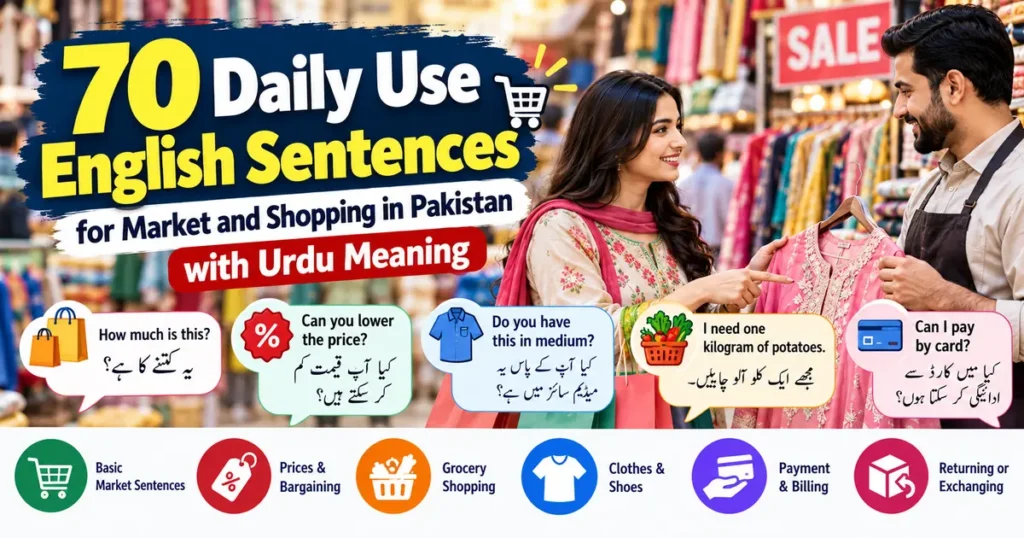
Want to speak English while shopping in a Pakistani market? Start with simple sentences such as “How much is this?” (یہ کتنے کا ہے؟), “Can you lower the price?” (کیا آپ قیمت کم کر سکتے ہیں؟), and “Please pack this for me.” (براہِ کرم یہ میرے لیے پیک کر دیں۔)
This lesson includes 70 daily use English sentences for market and shopping with Urdu translation. You will learn how to ask prices, buy groceries, bargain with shopkeepers, choose clothes, make payments, and return products.
These sentences are useful for beginners, students, customers, and shopkeepers in Pakistan. You can practise them at a local bazaar, grocery store, clothing shop, supermarket, or shopping mall.
Free PDF Download
Get all 70 market and shopping sentences with Urdu meaning in one printable PDF. Practise offline anytime.
Download Free PDF70 English Sentences for Market and Shopping with Urdu Translation
Shopping conversations usually follow a simple order. First, you greet the shopkeeper. Then, you ask about a product, check its price, and decide whether to buy it. Finally, you pay and collect your purchase.
The following English and Urdu sentences follow that natural shopping process.
1. Basic English Sentences Used in a Market
These 12 market sentences help you start a conversation, ask for products, and communicate with a shopkeeper.
| English Sentence | Urdu Translation |
|---|---|
| 1. How much is this? | یہ کتنے کا ہے؟ |
| 2. I want to buy this. | میں یہ خریدنا چاہتا ہوں۔ |
| 3. Please show me that item. | براہِ کرم مجھے وہ چیز دکھائیں۔ |
| 4. Do you have this in stock? | کیا یہ چیز آپ کے پاس موجود ہے؟ |
| 5. I am just looking. | میں صرف دیکھ رہا ہوں۔ |
| 6. Where can I find this item? | مجھے یہ چیز کہاں مل سکتی ہے؟ |
| 7. I need something cheaper. | مجھے کوئی سستی چیز چاہیے۔ |
| 8. Do you have a better one? | کیا آپ کے پاس اس سے بہتر چیز ہے؟ |
| 9. Please show me another one. | براہِ کرم مجھے کوئی اور دکھائیں۔ |
| 10. I like this product. | مجھے یہ چیز پسند ہے۔ |
| 11. I don’t need this right now. | مجھے ابھی اس کی ضرورت نہیں ہے۔ |
| 12. I will come back later. | میں بعد میں واپس آؤں گا۔ |
Example: When you enter a shop in Lahore, Karachi, or another Pakistani city, you can say, “Excuse me, do you have this in stock?” This is a polite way to ask whether a product is available.
2. English Sentences for Asking Prices and Bargaining
Bargaining means discussing a price with a seller to reach an acceptable amount. It is useful in markets where sellers are willing to negotiate.
Learn these English sentences for asking prices and requesting discounts.
| English Sentence | Urdu Translation |
|---|---|
| 13. What is the price of this shirt? | اس شرٹ کی قیمت کیا ہے؟ |
| 14. This is too expensive. | یہ بہت مہنگا ہے۔ |
| 15. Can you lower the price? | کیا آپ قیمت کم کر سکتے ہیں؟ |
| 16. What is your best price? | آپ کی سب سے مناسب قیمت کیا ہے؟ |
| 17. Can you give me a discount? | کیا آپ مجھے رعایت دے سکتے ہیں؟ |
| 18. I can pay five hundred rupees. | میں پانچ سو روپے دے سکتا ہوں۔ |
| 19. Is the price fixed? | کیا قیمت مقرر ہے؟ |
| 20. Can you make it a little cheaper? | کیا آپ اسے تھوڑا سستا کر سکتے ہیں؟ |
| 21. That is beyond my budget. | یہ میرے بجٹ سے باہر ہے۔ |
| 22. I will buy two if you give me a discount. | اگر آپ رعایت دیں تو میں دو خرید لوں گا۔ |
| 23. This price is reasonable. | یہ قیمت مناسب ہے۔ |
| 24. That is my final offer. | یہ میری آخری پیشکش ہے۔ |
Useful distinction: “How much is this?” asks for a product’s price. “Can you lower the price?” asks the seller to reduce it.
The English word bargain can also describe something purchased at a particularly good price. You can check its meaning and pronunciation in the Cambridge English–Urdu Dictionary.
3. English Sentences for Grocery and Vegetable Shopping
Grocery shopping involves buying everyday food and household items. These sentences help you purchase vegetables, fruit, flour, rice, and other products.
| English Sentence | Urdu Translation |
|---|---|
| 25. I need one kilogram of potatoes. | مجھے ایک کلو آلو چاہییں۔ |
| 26. How much are the tomatoes per kilogram? | ٹماٹر فی کلو کتنے کے ہیں؟ |
| 27. Please give me fresh vegetables. | براہِ کرم مجھے تازہ سبزیاں دیں۔ |
| 28. Are these mangoes sweet? | کیا یہ آم میٹھے ہیں؟ |
| 29. I need half a kilogram of onions. | مجھے آدھا کلو پیاز چاہیے۔ |
| 30. Do you have fresh milk? | کیا آپ کے پاس تازہ دودھ ہے؟ |
| 31. Please weigh these apples. | براہِ کرم ان سیبوں کا وزن کریں۔ |
| 32. I need a five-kilogram bag of flour. | مجھے پانچ کلو آٹے کا تھیلا چاہیے۔ |
| 33. Do you sell basmati rice? | کیا آپ باسمتی چاول فروخت کرتے ہیں؟ |
| 34. Please remove the damaged fruit. | براہِ کرم خراب پھل نکال دیں۔ |
| 35. How much does everything cost? | ان سب چیزوں کی کل قیمت کتنی ہے؟ |
| 36. Please put everything in one bag. | براہِ کرم تمام چیزیں ایک تھیلے میں رکھ دیں۔ |
Example: At a vegetable market, you can ask, “How much are the tomatoes per kilogram?” The seller might reply, “They are one hundred rupees per kilogram.”
This is an illustrative conversation, not a current market price.
4. English Sentences for Buying Clothes and Shoes
When shopping for clothes or shoes, customers often ask about size, colour, material, quality, and fitting.
| English Sentence | Urdu Translation |
|---|---|
| 37. Do you have this shirt in medium? | کیا آپ کے پاس یہ شرٹ میڈیم سائز میں ہے؟ |
| 38. Can I try this on? | کیا میں اسے پہن کر دیکھ سکتا ہوں؟ |
| 39. Where is the fitting room? | کپڑے پہن کر دیکھنے کا کمرہ کہاں ہے؟ |
| 40. This shirt is too tight. | یہ شرٹ بہت تنگ ہے۔ |
| 41. These shoes are too loose. | یہ جوتے بہت ڈھیلے ہیں۔ |
| 42. Do you have this in black? | کیا آپ کے پاس یہ کالے رنگ میں ہے؟ |
| 43. I need a larger size. | مجھے بڑا سائز چاہیے۔ |
| 44. Is this made of cotton? | کیا یہ سوتی کپڑے سے بنا ہے؟ |
| 45. Does this colour fade after washing? | کیا دھونے کے بعد اس کا رنگ پھیکا پڑ جاتا ہے؟ |
| 46. Please show me some casual shoes. | براہِ کرم مجھے روزمرہ استعمال کے کچھ جوتے دکھائیں۔ |
| 47. This size fits me perfectly. | یہ سائز مجھے بالکل ٹھیک آتا ہے۔ |
| 48. I will take this dress. | میں یہ لباس لے لوں گا۔ |
Speaking tip: Use “Can I try this on?” for clothes and other wearable items. Use “Can I test this?” when asking to check how a device works.
5. English Sentences for Payment and Billing
After selecting a product, you need to ask about the total amount, payment methods, and receipt.
| English Sentence | Urdu Translation |
|---|---|
| 49. What is the total amount? | کل رقم کتنی ہے؟ |
| 50. Can I pay in cash? | کیا میں نقد ادائیگی کر سکتا ہوں؟ |
| 51. Do you accept debit cards? | کیا آپ ڈیبٹ کارڈ قبول کرتے ہیں؟ |
| 52. Can I pay by bank transfer? | کیا میں بینک ٹرانسفر کے ذریعے ادائیگی کر سکتا ہوں؟ |
| 53. Please give me a receipt. | براہِ کرم مجھے رسید دیں۔ |
| 54. Do you have change for a thousand rupees? | کیا آپ کے پاس ایک ہزار روپے کے کھلے پیسے ہیں؟ |
| 55. Please check the bill again. | براہِ کرم بل دوبارہ چیک کریں۔ |
| 56. I think there is a mistake in the bill. | میرے خیال میں بل میں غلطی ہے۔ |
| 57. Can you pack these items separately? | کیا آپ ان چیزوں کو الگ الگ پیک کر سکتے ہیں؟ |
| 58. Thank you for your help. | آپ کی مدد کا شکریہ۔ |
A receipt is proof that a payment or transaction has taken place. You can find its meaning and pronunciation in the Cambridge English–Urdu Dictionary.
6. English Sentences for Returning or Exchanging Products
Sometimes a purchased item is damaged, defective, or unsuitable. These sentences help you explain the problem politely.
| English Sentence | Urdu Translation |
|---|---|
| 59. I bought this yesterday. | میں نے یہ کل خریدا تھا۔ |
| 60. This product is damaged. | یہ چیز خراب ہے۔ |
| 61. Can I exchange this item? | کیا میں یہ چیز تبدیل کر سکتا ہوں؟ |
| 62. I would like a refund. | میں اپنی رقم واپس لینا چاہتا ہوں۔ |
| 63. What is your return policy? | آپ کی چیز واپس کرنے کی پالیسی کیا ہے؟ |
| 64. I have the original receipt. | میرے پاس اصل رسید موجود ہے۔ |
| 65. This product does not work properly. | یہ چیز صحیح طریقے سے کام نہیں کرتی۔ |
| 66. Can you replace it with a new one? | کیا آپ اس کی جگہ نئی چیز دے سکتے ہیں؟ |
| 67. I received the wrong item. | مجھے غلط چیز ملی ہے۔ |
| 68. My order has not arrived yet. | میرا آرڈر ابھی تک نہیں پہنچا۔ |
| 69. How long will the refund take? | رقم واپس ملنے میں کتنا وقت لگے گا؟ |
| 70. Please help me resolve this issue. | براہِ کرم یہ مسئلہ حل کرنے میں میری مدد کریں۔ |
Remember: An exchange means replacing one item with another. A refund means getting your money back. Whether a shop accepts a return or exchange depends on its applicable policy and legal obligations.
English Conversation Between a Customer and Shopkeeper with Urdu Translation
A market conversation becomes easier when you practise questions and answers together.
Conversation 1: Buying Clothes at a Market
Customer: Excuse me, how much is this shirt?
Urdu: معاف کیجیے، یہ شرٹ کتنے کی ہے؟
Shopkeeper: It costs fifteen hundred rupees.
Urdu: اس کی قیمت پندرہ سو روپے ہے۔
Customer: Do you have it in blue?
Urdu: کیا آپ کے پاس یہ نیلے رنگ میں ہے؟
Shopkeeper: Yes, we do. What size do you need?
Urdu: جی ہاں، ہے۔ آپ کو کون سا سائز چاہیے؟
Customer: I need a medium size. Can I try it on?
Urdu: مجھے میڈیم سائز چاہیے۔ کیا میں اسے پہن کر دیکھ سکتا ہوں؟
Shopkeeper: Of course. The fitting room is over there.
Urdu: جی بالکل۔ کپڑے پہن کر دیکھنے کا کمرہ وہاں ہے۔
Customer: It fits well. Can you give me a discount?
Urdu: یہ مجھے ٹھیک آ رہی ہے۔ کیا آپ مجھے رعایت دے سکتے ہیں؟
Shopkeeper: I can give it to you for thirteen hundred rupees.
Urdu: میں آپ کو یہ تیرہ سو روپے میں دے سکتا ہوں۔
Customer: That sounds good. I will take it.
Urdu: یہ قیمت مناسب ہے۔ میں یہ لے لوں گا۔
Conversation 2: Buying Vegetables from a Shopkeeper
Customer: How much are the potatoes today?
Urdu: آج آلو کتنے کے ہیں؟
Shopkeeper: They are eighty rupees per kilogram.
Urdu: یہ اسی روپے فی کلو ہیں۔
Customer: Please give me two kilograms.
Urdu: براہِ کرم مجھے دو کلو دے دیں۔
Shopkeeper: Would you like anything else?
Urdu: کیا آپ کو کچھ اور چاہیے؟
Customer: Yes, I also need one kilogram of onions.
Urdu: جی ہاں، مجھے ایک کلو پیاز بھی چاہیے۔
Shopkeeper: Anything else?
Urdu: کچھ اور چاہیے؟
Customer: No, thank you. How much is the total?
Urdu: نہیں، شکریہ۔ کل کتنے پیسے ہوئے؟
Shopkeeper: Your total is two hundred and twenty rupees.
Urdu: آپ کے کل دو سو بیس روپے ہوئے۔
These amounts are fictional examples for English speaking practice.
Common English Shopping Words with Urdu Meanings
Understanding shopping vocabulary helps you create new sentences instead of memorising every expression separately.
| English Word | Urdu Meaning |
|---|---|
| Market | بازار |
| Shopkeeper | دکاندار |
| Customer | گاہک |
| Price | قیمت |
| Discount | رعایت |
| Bargain | سستا سودا |
| Expensive | مہنگا |
| Cheap | سستا |
| Quality | معیار |
| Quantity | مقدار |
| Weight | وزن |
| Kilogram | کلوگرام |
| Size | سائز |
| Colour | رنگ |
| Cash | نقد رقم |
| Payment | ادائیگی |
| Receipt | رسید |
| Refund | رقم کی واپسی |
| Exchange | تبادلہ |
| Warranty | وارنٹی |
For more useful words beyond shopping, explore our English vocabulary with Urdu meanings.
How to Make Your Own English Sentences for Shopping
You do not need to memorise hundreds of sentences separately. Learn a few sentence patterns and change the product, price, size, or quantity.
Pattern 1: How much is + singular item?
Use this pattern to ask about the price of one product.
- How much is this bag? — یہ بیگ کتنے کا ہے؟
- How much is this watch? — یہ گھڑی کتنے کی ہے؟
- How much is this book? — یہ کتاب کتنے کی ہے؟
For plural products, use How much are.
Example: How much are these shoes? — یہ جوتے کتنے کے ہیں؟
Pattern 2: I need + quantity + item
Use this pattern when asking for a specific amount of something.
- I need two kilograms of rice. — مجھے دو کلو چاول چاہیے۔
- I need three bottles of water. — مجھے پانی کی تین بوتلیں چاہییں۔
- I need a pair of shoes. — مجھے ایک جوڑا جوتے چاہیے۔
Pattern 3: Do you have + item?
Use this pattern to ask whether a product is available.
- Do you have fresh bread? — کیا آپ کے پاس تازہ ڈبل روٹی ہے؟
- Do you have black shoes? — کیا آپ کے پاس کالے جوتے ہیں؟
- Do you have a smaller bag? — کیا آپ کے پاس چھوٹا بیگ ہے؟
Pattern 4: Can I + verb?
Use this pattern to ask permission or make a polite request.
- Can I see this? — کیا میں یہ دیکھ سکتا ہوں؟
- Can I try these shoes on? — کیا میں یہ جوتے پہن کر دیکھ سکتا ہوں؟
- Can I pay tomorrow? — کیا میں کل ادائیگی کر سکتا ہوں؟
These patterns also appear in other everyday conversations. Practise more examples in our English sentences with Urdu meanings lesson.
Common English Mistakes While Shopping
Urdu-speaking beginners sometimes translate shopping expressions word for word. The meaning may be understandable, but the English sentence can sound unnatural.
| Less Natural or Incorrect | Correct English |
|---|---|
| What is the rate of this shirt? | How much is this shirt? |
| Give me less price. | Can you lower the price? |
| I want two kilo apple. | I want two kilograms of apples. |
| I am having five hundred rupees. | I have five hundred rupees. |
| Can you make discount? | Can you give me a discount? |
| This shoes is expensive. | These shoes are expensive. |
Why do these corrections matter?
Price versus rate: Use price for the cost of a product. Rate is common when discussing a price per unit, an exchange rate, or a charge for a service.
This versus these: Use this for one item and these for multiple items. Shoes are normally treated as plural.
Kilogram versus kilograms: Use kilogram after one and kilograms after numbers greater than one.
Give a discount: This is a natural English expression for requesting a reduction in price.
How Can Beginners Practise Market English at Home?
You can practise shopping English without visiting a market. Try this simple routine.
- Choose five sentences: Start with price questions, product requests, and payment expressions.
- Read the Urdu meanings: Make sure you understand what each sentence communicates.
- Speak aloud: Repeat each English sentence slowly and clearly.
- Practise both roles: Act as the customer first, then respond as the shopkeeper.
- Change the details: Replace “shirt” with “bag,” “rice,” or “shoes” to create new sentences.
For example, begin with “How much is this bag?” Then practise “How much is this watch?” and “How much is this book?”
This exercise helps you use the same grammatical structure in different shopping situations.
If you need more guidance with pronunciation, sentence formation, and grammar, follow our free spoken English language course.
Free PDF Download
Save the full list of 70 shopping sentences with Urdu meaning and practise at home, in the market, or on your phone.
Download Free PDFFrequently Asked Questions About English Sentences for Shopping
What are the most common English sentences used in a market?
Common market sentences include “How much is this?”, “Do you have this?”, “Can you lower the price?”, “I want to buy this,” and “Please give me a receipt.” These expressions help customers ask prices, find products, bargain, and complete purchases.
How do you ask the price of something in English?
You can say “How much is this?” or “How much does this cost?” For multiple items, ask “How much are these?” All three expressions are natural ways to ask about prices.
How can I bargain in English with a shopkeeper?
Use polite expressions such as “Can you give me a discount?”, “What is your best price?”, or “Can you make it a little cheaper?” These sentences allow you to negotiate without sounding rude.
What should I say when buying vegetables in English?
You can say “I need one kilogram of potatoes,” “Are these vegetables fresh?”, or “How much are the tomatoes per kilogram?” These expressions communicate the item, quantity, and price clearly.
How do you speak English in a clothing shop?
Start by asking whether the shop has your preferred size or colour. Then use sentences such as “Can I try this on?”, “Do you have a larger size?”, and “This fits me perfectly.”
What is the English word for مول تول?
The Urdu expression مول تول کرنا can be translated as to bargain or to haggle. Both refer to negotiating a price, especially when buying or selling something.
What is the difference between a discount and a refund?
A discount reduces the price of a product before or during purchase. A refund returns money to a customer after a payment has been made.
How can Pakistani beginners improve their shopping English?
Begin with short, practical sentences. Learn their Urdu meanings, practise speaking them aloud, and use them in sample conversations. Focus on asking prices, requesting products, discussing quantities, and making payments before learning more advanced expressions.
Final Thoughts
Learning English sentences for market and shopping with Urdu translation helps you communicate clearly in everyday buying and selling situations.
Start with five essential expressions: “How much is this?”, “Do you have this?”, “Can you lower the price?”, “I will take it,” and “Please give me a receipt.”
Once you feel comfortable, practise the remaining sentences for grocery shopping, clothes, shoes, payments, and returns. Use the conversation examples to connect individual sentences into natural spoken English.
Your next step: Choose ten sentences from this lesson, read their Urdu meanings, and practise a complete customer-and-shopkeeper conversation today.