

Time words in English are the small words you use all day. Today, tomorrow, yesterday, morning, evening, night, week, month, and year help you talk about plans, habits, and past events. This guide gives you 14 of them with Urdu meanings, Roman Urdu, and a simple example sentence for each one. You also get the common mistakes Urdu speakers make and a free PDF to practise offline.
14 Time Words in English With Urdu Meanings
Read the table first. Then say each example sentence out loud two times. Speaking helps you remember a word faster than reading alone.
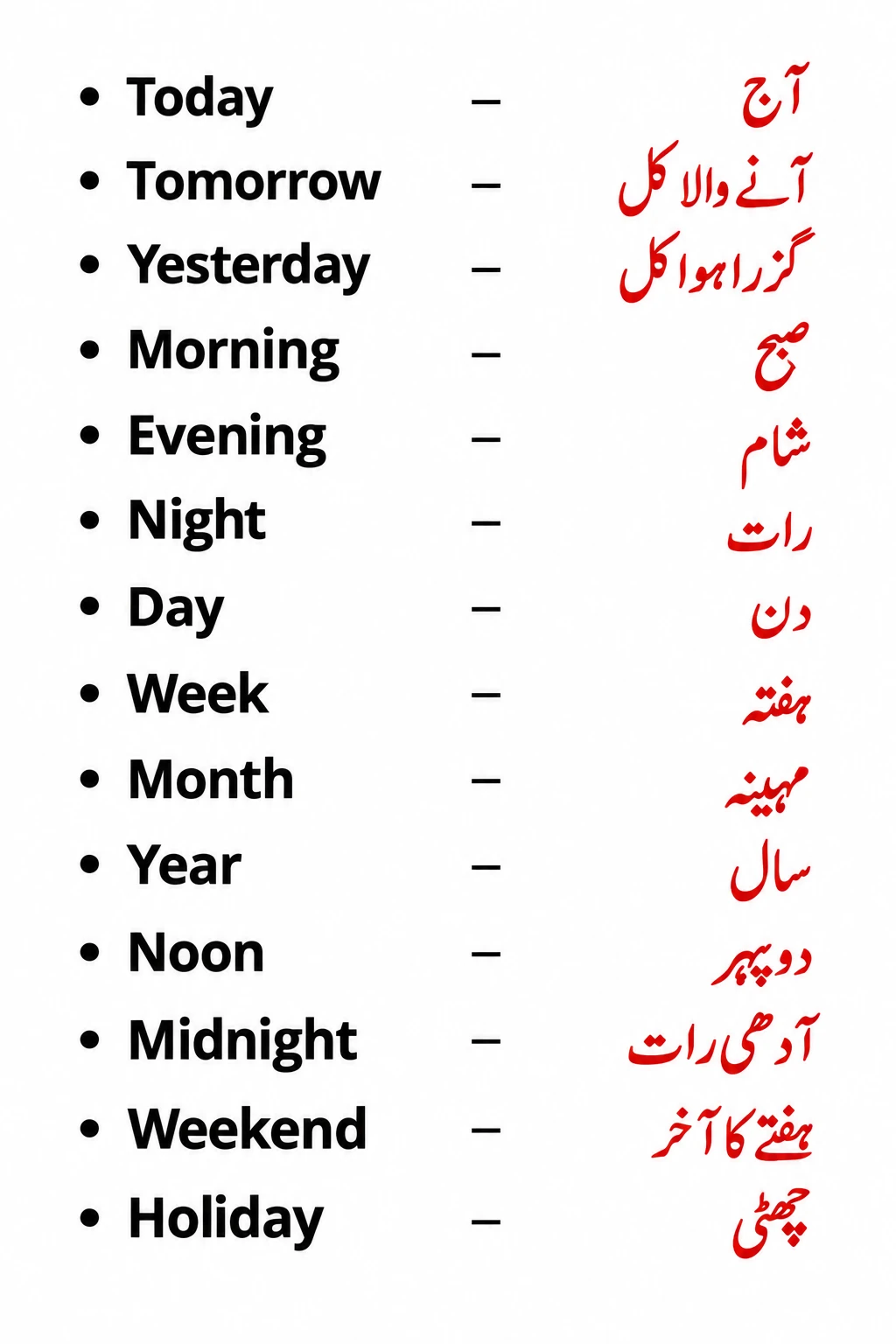
| English | Urdu | Roman Urdu | Example sentence |
|---|---|---|---|
| Today | آج | aaj | I have a class today. |
| Tomorrow | آنے والا کل | aane wala kal | I will call you tomorrow. |
| Yesterday | گزرا ہوا کل | guzra hua kal | I studied English yesterday. |
| Morning | صبح | subah | I walk in the morning. |
| Evening | شام | shaam | We drink tea in the evening. |
| Night | رات | raat | I read a book at night. |
| Day | دن | din | It was a long day. |
| Week | ہفتہ | hafta | I practise English every week. |
| Month | مہینہ | mahina | This month is very busy. |
| Year | سال | saal | The year ends in December. |
| Noon | دوپہر | dopahar | We meet at noon. |
| Midnight | آدھی رات | aadhi raat | The shop closes at midnight. |
| Weekend | ہفتے کا آخر | hafte ka aakhir | I rest at the weekend. |
| Holiday | چھٹی | chhutti | Tomorrow is a holiday. |
Want more words after this list? Browse our page of English vocabulary with Urdu meanings. Every word there comes with an Urdu meaning and an example.
Today, Tomorrow, and Yesterday: The Three Core Time Words
Today means the present day. Tomorrow means the day after today. Yesterday means the day before today.
Urdu uses one word, kal, for both yesterday and tomorrow. You understand the meaning from the sentence. English does not work this way. English has two separate words, so you must choose the right one.
Compare these two sentences.
- Main kal school gaya tha. = I went to school yesterday.
- Main kal school jaunga. = I will go to school tomorrow.
Look at the verb. A past verb points to yesterday. A future verb points to tomorrow. This small trick saves you from many mistakes.
Morning, Evening, Night, Noon, and Midnight
These words describe parts of the day. Morning is the early part of the day. Noon is twelve o’clock in the middle of the day. Evening comes after the afternoon. Night is the dark part of the day. Midnight is twelve o’clock at night.
Which preposition should you use?
Prepositions confuse many beginners. Use this simple rule.
- Use in with morning, afternoon, and evening: in the morning, in the evening.
- Use at with night, noon, and midnight: at night, at noon, at midnight.
Yesterday, today, and tomorrow with parts of the day
These phrases are very common in daily speaking. Learn them as fixed chunks.
- Yesterday morning, yesterday afternoon, yesterday evening.
- For night, say last night. Do not say “yesterday night.”
- This morning, this afternoon, this evening.
- For night, say tonight. Do not say “this night.”
- Tomorrow morning, tomorrow afternoon, tomorrow evening, tomorrow night.
Day, Week, Month, and Year
These four words measure longer time. A day has twenty-four hours. A week has seven days. A month is a part of the year, such as January or March. A year has twelve months.
Use these prepositions with them.
- Use in with months and years: in March, in 2026.
- Use on with days and dates: on Monday, on 14 August.
You can also add every, last, and next to these words. For example: every week, last month, next year. These phrases need no preposition.
Weekend and Holiday
The weekend is the end of the week, usually Saturday and Sunday in many countries. A holiday is a day when people do not go to work or school. In Urdu, we say chhutti.
Here is a useful note about the weekend. British English says at the weekend. American English says on the weekend. Both are correct, so choose one style and stay consistent.
5 Common Mistakes Urdu Speakers Make With Time Words
1. Saying “yesterday night.” Say “last night” instead.
2. Saying “this night.” Say “tonight” instead.
3. Using “kal” thinking in English. Pick “yesterday” or “tomorrow” by checking the verb tense.
4. Saying “in night.” Say “at night.” Night uses at.
5. Using a preposition with “tomorrow” or “yesterday.” Do not say “on tomorrow.” Say “tomorrow.”
Short Practice Dialogue
Read this dialogue with a friend. Change the words in bold to make your own version.
Ali: Are you free tomorrow evening?
Sara: Yes, I am free. Tomorrow is a holiday.
Ali: Great. Let us meet at noon on the weekend instead.
Sara: Sorry, I am busy this weekend. I was busy last night too.
Ali: No problem. We can meet next week.
Want more ready-made lines for everyday talk? Try our list of English sentences with Urdu meanings.
7-Day Plan to Learn Time Words
- Day 1: Learn today, tomorrow, and yesterday. Make three sentences.
- Day 2: Learn morning, evening, and night. Practise in, at, and last night.
- Day 3: Learn noon and midnight. Say what you do at each time.
- Day 4: Learn day, week, month, and year. Add every, last, and next.
- Day 5: Learn weekend and holiday. Plan your next holiday in English.
- Day 6: Record yourself using all 14 words. Listen and fix mistakes.
- Day 7: Review the PDF. Say all example sentences without looking.
Need a full path from beginner to confident speaker? Start our free spoken English course. Prefer reading practice? Try the basic English reading course.
Where to Practise Next
After you learn these words, use them in real sentences. The site Grammareer shares 110 daily English speaking practice sentences with Urdu translations. You can also read short stories with Urdu translation and audio in the basic level section on English Translation in Urdu.
If you live in Lahore and want live feedback, you can also work with an English tutor in Lahore.
Free PDF Download: Time Words in English With Urdu Meanings
Get the full list of 14 words with Urdu, Roman Urdu, and example sentences. Print it or save it on your phone. It is free.
Frequently Asked Questions
What is the Urdu meaning of tomorrow?
Tomorrow means aane wala kal (آنے والا کل). It is the day after today.
What is the Urdu meaning of yesterday?
Yesterday means guzra hua kal (گزرا ہوا کل). It is the day before today.
What is the difference between noon and midnight?
Noon is twelve o’clock in the middle of the day. Midnight is twelve o’clock at night. In Urdu, noon is dopahar and midnight is aadhi raat.
Do we say “yesterday night” or “last night”?
Say “last night.” It is the natural phrase for the night before today.
Is it “at the weekend” or “on the weekend”?
Both are correct. British English uses “at the weekend.” American English uses “on the weekend.”
How many time words should I learn each day?
Learn three to five words a day. Use each one in a spoken sentence. Review them the next day.
Final Thoughts
Time words are the base of daily English. Once you know them, you can talk about your plans, your habits, and your past with confidence. Learn them in small groups. Speak every sentence out loud. Then download the free PDF and keep practising. To see how we teach, read about Prhlo or contact us with your questions.
Written by Usman Ali, ESL instructor and founder of Prhlo.com, a free spoken English platform for Urdu-speaking learners.