
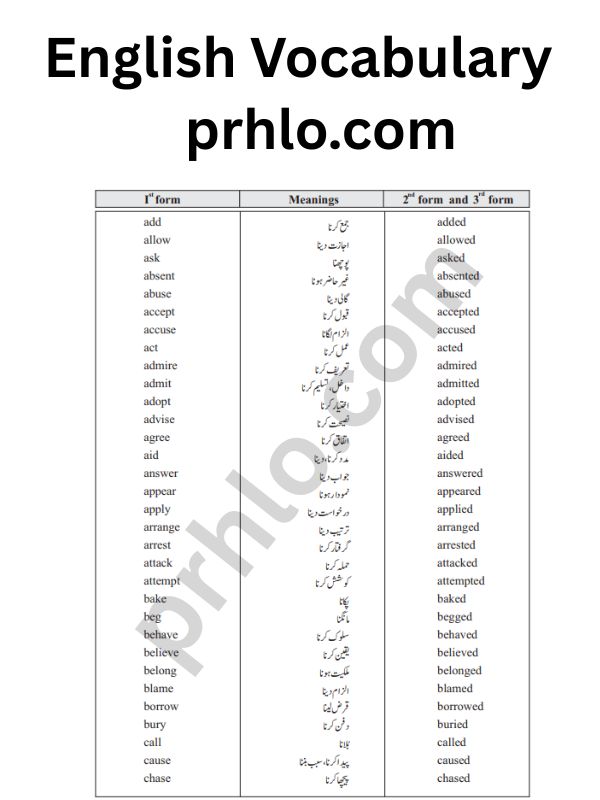
There is a civil war raging inside the English language, and the battlefield is the past tense. On one side, you have the obedient, predictable majority: the Weak Verbs. They clock in, add their “-ed” suffix, and go home. Talk becomes talked. Walk becomes walked. They are the dutiful civil servants of grammar. But then, there are the rebels. The Strong Verbs. They refuse to be suffixed. Instead of politely accepting an “-ed,” they change their very core, shifting vowels and altering consonants like linguistic shapeshifters. The image file “English Vocabulary (1).jpg” and the extensive tables found in the official English Grammar and Composition 9-10 PDF Guide (specifically Pages 2-3) capture this exact rebellion. These aren’t just lists; they are wanted posters for the outlaws of conjugation.
To truly master these verbs—the ones that trip up autocorrect and expose a non-native speaker faster than a mispronounced “th”—we must stop memorizing them as random noise and start recognizing the ancient music they make. Let’s dissect the unique patterns hidden in this specific data set, using insights that go far beyond rote learning.
Pattern 1: The “I-A-U” Echo of the Anglo-Saxons
Look at the sequence in both your image and Page 3 of the linked PDF: Ring, Sing, Sink, Spring, Shrink, Drink (and its cousin Begin). There is an almost hypnotic, drumbeat pattern here: I – A – U.
- Ring → Rang → Rung
- Sing → Sang → Sung
- Drink → Drank → Drunk
This is not a coincidence. This specific vowel graduation is a fossil of Proto-Germanic ablaut, the ancient system of changing vowels to indicate tense. When you say “I have sung the song” instead of “I have singed,” you are not just being grammatically correct; you are channeling the vocal patterns of tribes that wandered Northern Europe over 2,500 years ago. The PRHLO.com vocabulary table serves as a modern-day archaeological dig site for these sounds. Mastering the “I-A-U” triplet unlocks a huge chunk of the English lexicon.
Pattern 2: The Survivors of the “-en” Apocalypse
One of the most fascinating insights when comparing your image to the PDF’s Page 10 (the “Weak Verbs” list) is the survival of the -en suffix. Modern English largely killed the “-en” ending for past participles. We don’t say “I have helpen” anymore; we say “helped.” But this list shows that a stubborn group of high-frequency verbs absolutely refused to let go.
- Write → Wrote → Written (Note the double ‘t’ trap!)
- Ride → Rode → Ridden
- Rise → Rose → Risen
- Speak → Spoke → Spoken
- Steal → Stole → Stolen
If you rely on the logic of regular verbs, you will instinctively want to say “I have wrote” or “I have spoke.” The “-en” is the grammatical barbed wire protecting the correct form. As you advance from basic lists on sites like PRHLO.com to more complex composition, the ability to instinctively add that “-en” (and double the ‘t’ in written) is the hallmark of an advanced user.
Pattern 3: The Identity Crisis of “Wind” and “Wound”
The final entry in the image, “Wind,” is the ultimate test of context and the most dangerous word on this list. The table shows:
Wind → Wound → Wound
This is a trap that requires differentiation, a skill the PDF guide emphasizes through its “Meanings” column.
- Wind (verb, pronounced Wīnd): To wrap around, to twist. Past tense: Wound (pronounced Wownd). Example: I wound the clock yesterday.
- Wound (verb, pronounced Woond): To injure. Past tense: Wounded. Example: The soldier was wounded in battle.
The image blurs them together, but a sharp learner using this data sees the collision of two different verbs. The irregular past of “Wind” (twist) happens to be spelled exactly like the present tense of “Wound” (injure). This is the kind of linguistic nuance that separates reading a JPG from understanding the full scope of the English Grammar and Composition curriculum.
The Visual “Meanings”: A Mnemonic Bridge with Caution
It’s impossible to ignore the third column in the user’s image. The script (رَدّ, سِعّ, تَحْشّ) is not a direct translation. It is a homemade phonetic bridge. For an Urdu or Arabic speaker, “Think” sounds nothing like its spelling. The user has written تَحْشّ (Tah-sh) to remind themselves of the sound “Thought.” While this is a powerful personal mnemonic strategy, it is a double-edged sword. The actual meanings found in the PDF—where “Think” is correctly aligned with its definition—are necessary to avoid fossilizing incorrect pronunciation based on a different alphabet’s limitations.
Conclusion: Honoring the Rebels
The “English Vocabulary (1).jpg” file and the systematic tables of the 9th-10th grade grammar PDF are two sides of the same coin. One is the field notes from the front lines of learning; the other is the official military strategy guide.
Do not approach this list with dread. Approach it like a linguist. Listen for the Ring-Rang-Rung drumbeat. Feel the ancient weight of Written and Ridden. Recognize the shapeshifter Wind. These irregular verbs are not errors in the English system; they are the living history of the language. They are the fingerprints of Beowulf and Chaucer on your smartphone screen. Every time you correctly use “Ridden” instead of “Rided,” you are not just speaking English—you are curating a museum of sound.