
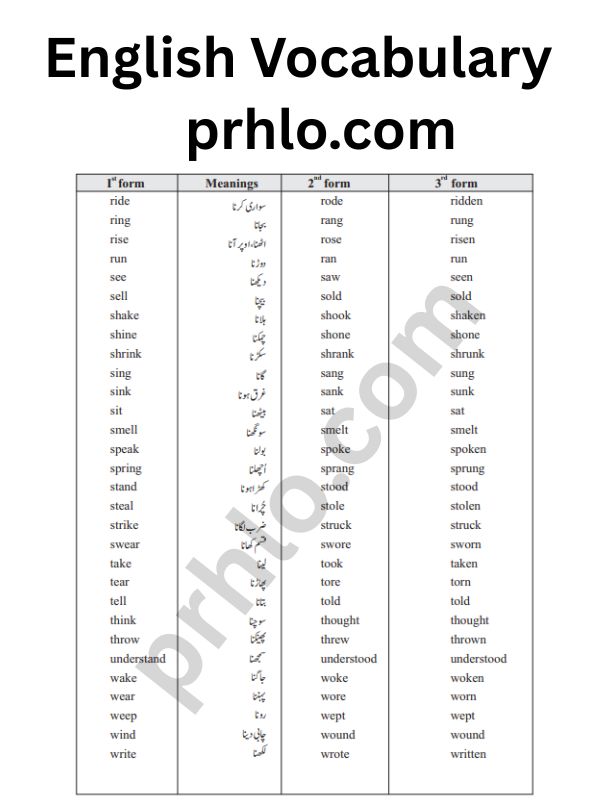
For millions of English learners navigating resources like PRHLO.com , the image above represents a familiar battleground. It’s a stark, three-column grid that separates the casual speaker from the proficient writer. The file titled “English Vocabulary (1).jpg” is not just a list; it is a map of linguistic rebellion. While the adjacent phonetic script might require a second look to decipher intent, the English columns themselves tell a story of the Germanic Strong Verb—a class of words that refuses to follow the lazy “-ed” rule.
Let’s take a unique journey through this specific dataset, focusing not on memorization, but on pattern recognition to make these 30 verbs stick forever.
The “I-A-U” Dynasty: The Vowel Shift of Ancient England
Look closely at the list from “Ring” to “Spring.” You’ll notice a dominant, almost musical pattern: I – A – U.
- Ring → Rang → Rung
- Sing → Sang → Sung
- Sink → Sank → Sunk
- Spring → Sprang → Sprung
This is not random. This specific vowel graduation is a fossilized echo of Old English and Proto-Germanic. When you sing a song, your voice rings; these words mimic the action. They are visceral, physical verbs often associated with movement or sound. If you can master the “I-A-U” triplet for these five words, you unlock the logic for a dozen more. The table also offers a cousin pattern with “Shrink” → “Shrank” → “Shrunk,” which follows the exact same vocalic footprint.
The Stubborn “-en” Survivors
Another unique insight from this specific PRHLO table is the survival of the “-en” suffix in the third form. In modern English, we’ve largely shed this ending (we no longer say “I have helpen“), but it clings to life in this list:
- Ride → Rode → Ridden
- Rise → Rose → Risen
- Speak → Spoke → Spoken
- Steal → Stole → Stolen
- Write → Wrote → Writen
Notice the spelling trap here: “Write” drops the ‘e’ to become “Written,” just as “Ride” becomes “Ridden.” The brain wants to spell it “Writen,” but the double ‘t’ is the gatekeeper of correct grammar. Mastering this nuance is what separates a casual user of an app like PRHLO.com from someone who truly internalizes the structure of the language.
The “No-Change” Rebels and The Identity Crisis
One of the most perplexing sections of the image for Urdu/Hindi speakers (who might be using the adjacent script) is the “Set” group, represented here by Hit (implied pattern) and Run.
- Run → Ran → Run
- Come → Came → Come
This is the “Boomerang Pattern.” The word changes in the past tense (Ran) but snaps back to its original shape for the perfect tense (Have Run). This is a common source of error; you will hear native children say “I have ran” quite often. The correct form is “I have run.”
The Silent Nightmare: “Wind” vs. “Wound”
The final word on the list, “Wind,” is the ultimate test of this chart’s value. The image lists:
Wind → Wound → Wounded
Here, context is everything, and this is where the phonetic hints in the image (however unconventional) might actually signal a warning. There are two verbs here:
- Wind (Pronounced Waind): To wrap or twist. Past tense: Wound (Pronounced Wownd). I wound the clock.
- Wound (Pronounced Woond): To injure. Past tense: Wounded. The soldier was wounded.
The table combines them, but a sharp student using this resource learns that “Wind” (air) and “Wind” (twist) are homographs with different fates.
The Deeper Context: Beyond the JPG
While this JPG is a handy quick-reference, the odd transcription in the “Meanings” column highlights a common issue for self-learners: phonetic confusion across scripts. This is why moving beyond static images to comprehensive, structured audio resources is vital. For those looking to cement the correct pronunciation and usage of these verbs (and thousands more), you cannot rely on JPGs alone. A deeper dive into structured grammar is necessary.
For a more formal and exhaustive understanding of how these irregular verbs function within complex sentence structures, a curriculum-based resource is invaluable. You can explore the framework of English composition and grammatical rules as taught in academic settings through this comprehensive guide: English Grammar and Composition 9-10 PDF Guide . This link provides the foundational rules that explain why “I have spoke” is wrong and “I have spoken” is right.
Conclusion: The Art of Breaking the Rules Correctly
The “English Vocabulary (1).jpg” file is more than a list of words; it is a collection of linguistic survivors. Words like Tear/Tore/Torn and Swear/Swore/Sworn have resisted the flattening effect of modern English regularization.
As you study this table, do not just read down. Read across. Listen for the Ring-Rang-Rung melody. Feel the weight of the -en in Eaten and Fallen (even if not on this specific page). These are the secret passwords to sounding natural. The path to fluency is paved with these irregular stones, and each time you correctly choose “Written” over “Wrote” in a perfect sentence, you are honoring a thousand years of linguistic history.