
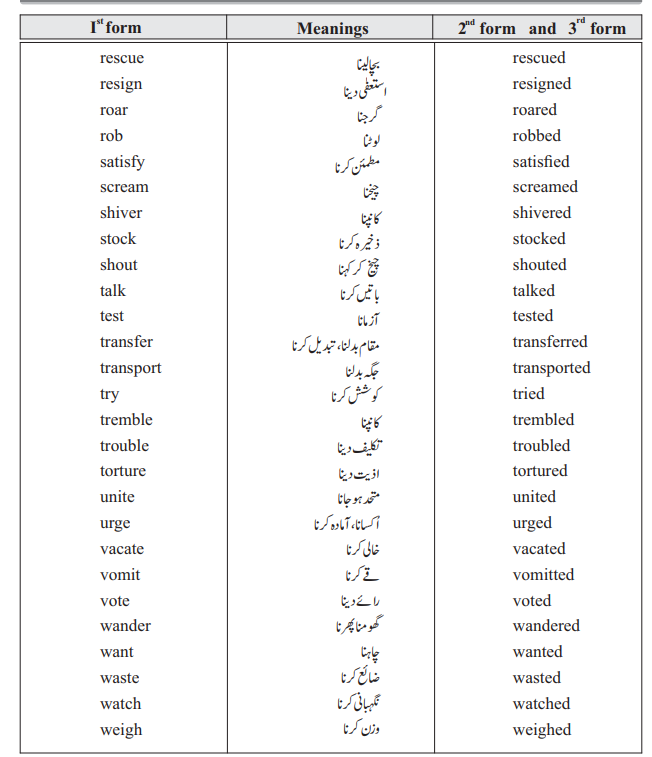
We’ve all been there: staring at a list of English vocabulary words, trying to memorize their different forms so we can finally speak or write with confidence. It often feels like a mechanical chore.
But if you look closely at a standard regular verb table—like the one right here—you’ll notice something fascinating. This isn’t just a list of dry grammatical rules; it’s a toolkit for human emotion, action, and storytelling.
Let’s dive into what makes this specific collection of words so powerful, and how you can actually master them without tearing your hair out.
1. The Comfort of the “Regular” Pattern
English gets a bad reputation for being chaotic (looking at you, buy/bought and go/went). But the verbs on this list show the beautifully predictable side of the language.
When a verb is regular, its 2nd form (Past Simple) and 3rd form (Past Participle) are identical twins, usually ending in -ed.
- rescue → rescued
- talk → talked
- waste → wasted
Spelling Pro-Tip: Notice how vomit becomes vomitted in this chart? In standard British and American English, it is actually spelled with a single ‘t’ (vomited), because the stress is on the first syllable (VO-mit). It’s a great reminder that even regular verbs like to keep us on our toes!
2. A Spectrum of Human Emotion
Look at the sheer variety of human experiences captured in just this single section of the alphabet (R to W):
The Intense Actions
- Scream / Shout / Roar: These aren’t just speech words; they carry volume, anger, or terror.
- Tremble / Shiver: Both translate to Kaanpna (کانپنا) in Urdu, but they tell different stories. You shiver because you’re cold; you tremble because you are absolutely terrified or deeply moved.
The Everyday Logistics
- Transfer / Transport / Vacate: The language of moving, changing spaces, and clearing out.
- Weigh / Stock / Test: The analytical, practical side of life.
3. The Power of Bilingual Bridges
For learners translating between English and Urdu, lists like this are incredibly grounding. Seeing Satisfy right next to Mutmain karna (مطمئن کرنا) or Urge next to Uksana/Aamada karna (اکسانا/آمادہ کرنا) bridges the gap between a foreign concept and a deeply understood feeling.
However, the real magic happens when you move away from the direct translation and start building your own context.
How to Actually Memorize This List (Without Boring Yourself to Tears)
Instead of reading this table up and down twenty times, try the Story-Chain Method. Pick 3 or 4 random verbs from the list and force them into a single, dramatic sentence.
- The Challenge: Connect Rescue, Shiver, and Vote.
- The Story: “After the coast guard rescued the stranded sailors, they sat shivering in blankets while they cast their vote on where to dock next.”
By forcing your brain to create a scenario, the 1st, 2nd, and 3rd forms lock into your long-term memory far better than rote memorization ever could.
Final Thoughts
Grammar charts aren’t a prison sentence; they are the scaffolding of your next great conversation. The next time you look at a vocabulary sheet, don’t just see columns—see the actions, emotions, and stories waiting to be told.
What’s your favorite verb from this list? Try writing your own three-word story chain in the comments below!